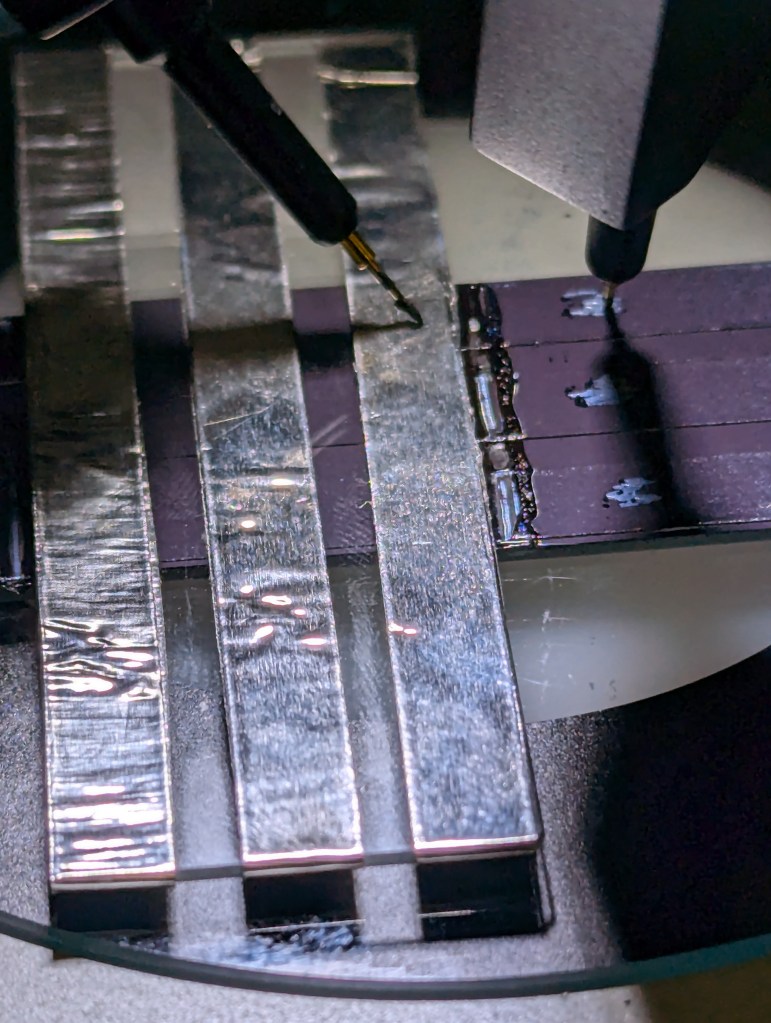
Halfway through the summer, we finally managed to bring everything together on the indigo electronics side–the thin film samples Lily & Yujen were making, an electronic probe setup that didn’t immediately wreck the fragile aluminum-indigo-carbon layer structures, and some test & measurement equipment gathered from around the lab:



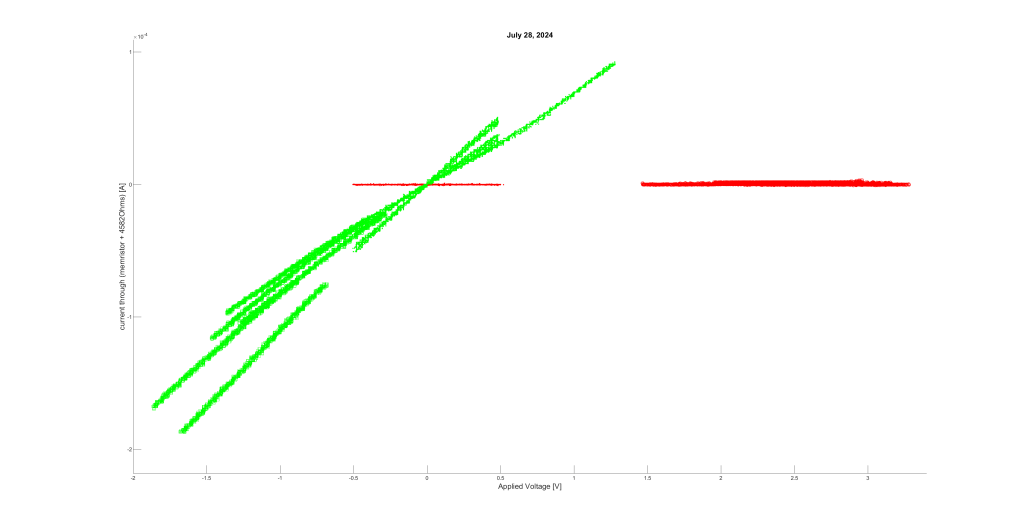
It took a few days to straighten out the required voltage polarity, but eventually we were able to record some traces that clearly demonstrated the same (more-or-less) memristor behavior reported in Nascimento et al., “Low-Cost, Printed Memristor Using Indigo and a Dispersion of Colloidal Graphite Deposited by Spray Coating” [IEEE Electron Device Letters 42, 1468 (2021)]. I ended up using a dab of aquadag paint rather than the graphite spray coating, and our aluminum substrates were not as clean as the ones in the paper (I suspect a thin oxide/grime layer between the aluminum and indigo adds a small capacitance element), but the basic effect was clear. Here for example is a plot of some data, showing both low-resistance (green points) and high-resistance (red points) states of the aluminum-indigo-carbon junction, with the overlap region around 0 applied voltage demonstrating bistability:

For posterity here’s a cell phone picture of an oscilloscope screen with one of the earliest traces showing resistance-state switching:

On the whole, these tests back in summer 2024 were both gratifying/relieving (it was nice to see that the memristor effect could be achieved without getting too super-technical about the device fabrication), but also revealed that the aluminum-indigo-carbon layer structures are mechanically rather fragile. This perhaps should not have been surprising, as the indigo layer is really just a bunch of loose grains sitting on an aluminum surface with no adhesive or embedding of any kind. Several times I managed to set up probes on a layer structure and have the memristor effect persist apparently unchanged overnight, but it was also clear that bumping the table could be enough to knock the setup out of whack. So I started wondering at this point about how feasible it could really be to make a large array of these memristor structures that would function properly over a sufficiently long time to make an exhibitable installation, as originally proposed…

 Silkpunk Dogu - Stanford VPA Faculty Creative Project 2023-2025