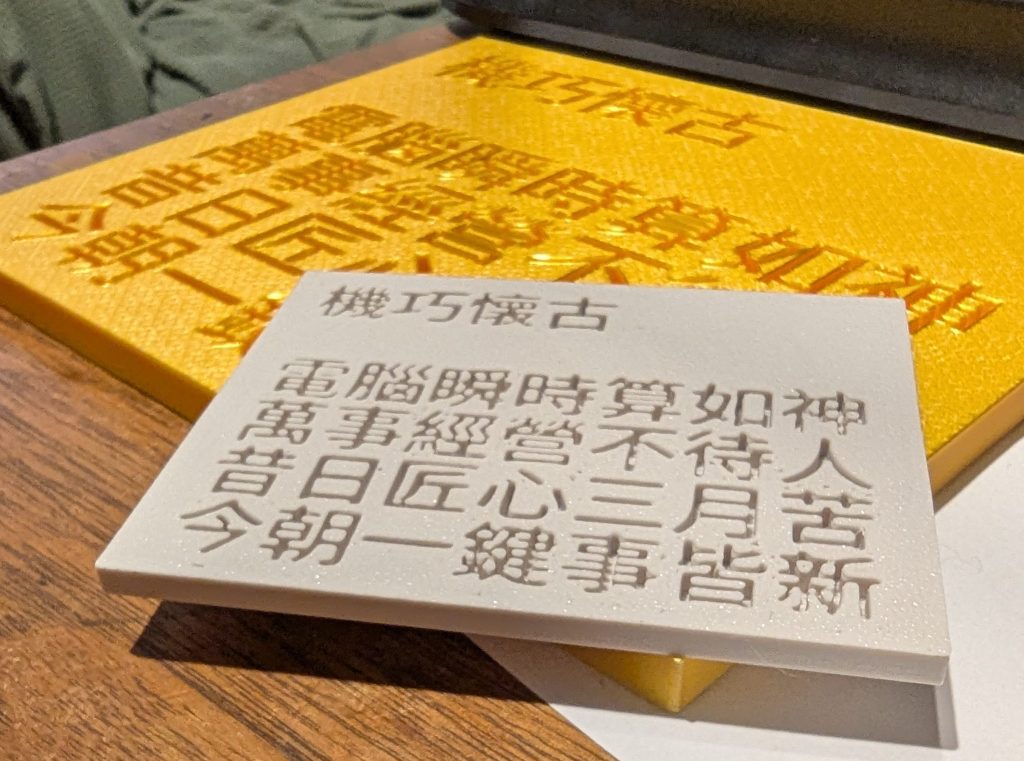
I can’t really remember when this happened, but at some point over the past year I realized that the silk-casting+indigo part of this Faculty Creative Project could find a natural home/venue in an exhibit I’m organizing with the Hohbach Hall Exhibits Program for spring-summer 2026 in Stanford’s Green Library.
The concept for the exhibit is to respond expansively to the Library’s acquisition of a book whose pages (text and ornament) were woven on a Jacquard loom in 1883. Initial thinking and research about the materiality of the book and the fabricator’s enigmatic choice of text—an excerpt from the novel Jocelyn by Alphonse de Lamartine—highlighted three sorts of questions for the exhibition: 1) what is the historical significance of this first “digitization” of a text within the Jacquard punch-card workflow and what was the broad historical context of its production; 2) why did the fabricator, J.-A. Henry, choose this specific Lamartine text and what do we know of his values as an industrialist and (as it turns out) public works advocate; and 3) can we imagine a contemporary version of something like the woven book that would draw together comparable socio-economic, cultural, and technological themes?
As a result of pursuing these questions, the exhibition is coming together as a synthesis of material relating to displacement of human labor by machines (from the Jacquard loom to AI), manipulation of working classes by the elite (from Lamartine and Henry’s deceptive agrarian romanticism to contemporary cyberocracy), and the surprising (as in, new to me) story of the nineteenth century collapse of European silk production and the failing Tokugawa Shogunate’s attempt to establish a silk-for-arms trade with Second Empire France. Inspired in large part by the latter theme, I am now planning to make (as a 2025 echo of the woven book) two materializations of AI-generated kanshi poems that combine 3D printing, bioengineering-inspired silk casting, and indigo dyeing…

 Silkpunk Dogu - Stanford VPA Faculty Creative Project 2023-2025